
Closing the Gap on Measuring the t8/5 Cooling Time for Welding
A torch-mounted thermal camera read cooling time live on every bead and every additive layer. It disagreed with EN 1011-2, and thermocouples sided with the camera.
Why it matters now?
In structural steel you have tens of seconds of margin. In high-strength steel you have a few. In WAAM you have a few on every layer.
At that margin, the gap between predicted and actual cooling time can be wider than the window itself.
What's new?
-
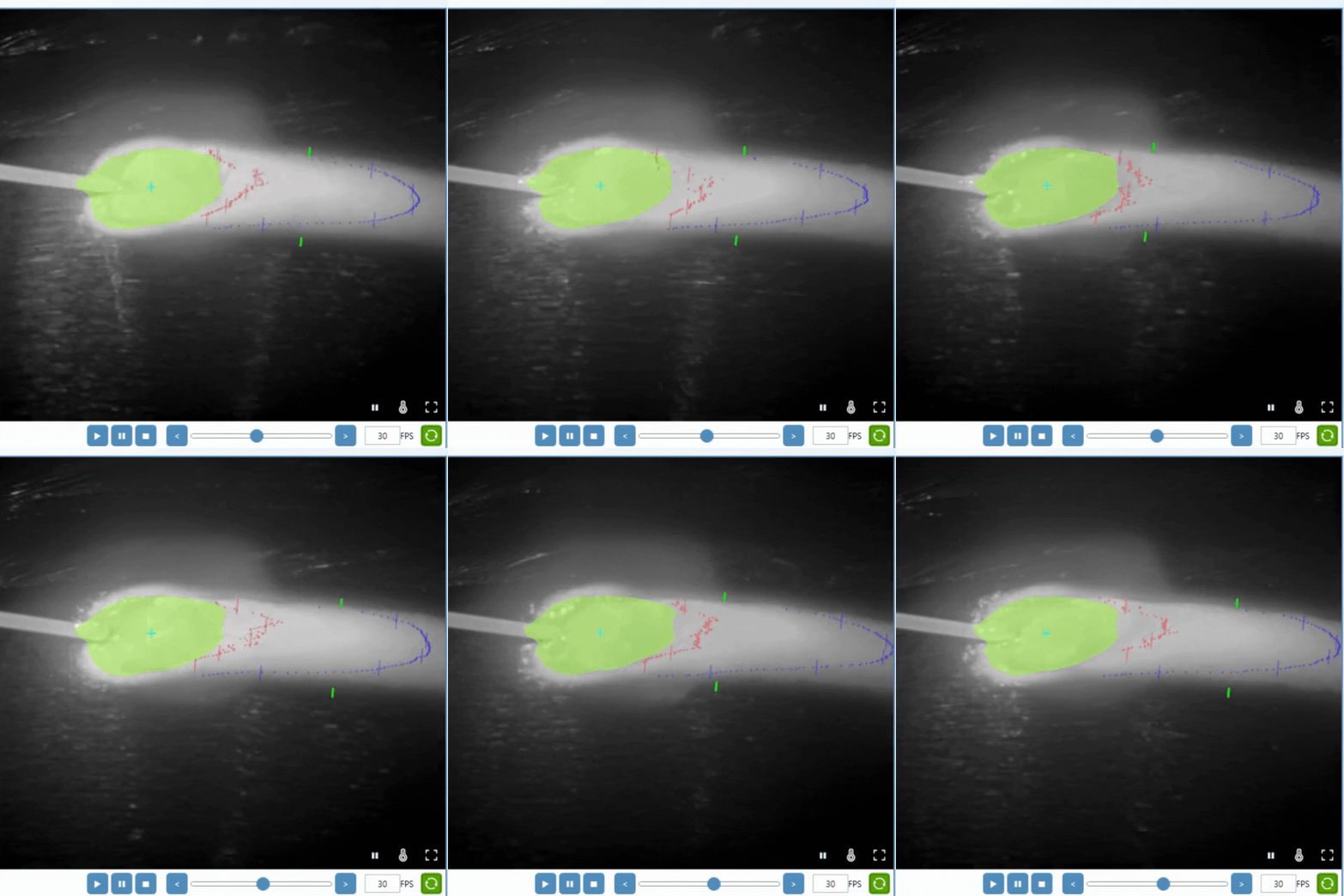
Measured, not modelled. t8/5 is read straight off the weld: the distance between the 800°C and 500°C isotherms divided by travel speed. You enter no heat input, no material properties and no geometry.
-
The formula ran short. Real welds cooled slower than EN 1011-2 predicted, by a repeatable factor between 1 and 2.
-
Every layer gets its own number. In WAAM and wire-laser builds, cooling time rose layer by layer, then levelled off. It also exposed inter-pass timing nobody was tracking.
-
It predicts hardness.Across all three processes, measured cooling time fell on one hardness curve, so you can check a part before you section it.
-
Not just t8/5. Set any interval, such as t12/8, to match your alloy.
Cross-checked against thermocouples and microhardness maps. Builds on work presented at IIW 2025, Commission XII.
GET THE WHITEPAPER


Cooling Time in Metal AM
Metal AM involves building parts layer by layer, and controlling cooling rates is crucial for:
-
Achieving uniform mechanical properties throughout the build.
-
Avoiding defects caused by uneven cooling.
Cooling time measurement applies to both wire-based and powder-based processes, including:
-
Wire-Based Processes: GMAW-based WAAM, Plasma-Arc-based WAAM, Wire Laser AM (WLAM), Wire-based Electron Beam AM.
-
Powder-Based Processes: Laser DED, Laser Powder Bed Fusion, Electron Beam AM.
For wire-based methods like WAAM and WLAM, cooling time measurement is particularly critical. Due to the layer-by-layer nature of these processes, cooling rates can vary significantly within a single build, making accurate monitoring essential.